My first physical AI robot

Mini Beacon — My First Physical AI Robot

Before Little Brain, there was a little robot on a wooden desk — and a first step into coding.

Before Mini Beacon, I had already created an AI-powered character, Agent 927. Mini Beacon was my first physical AI robot. Customising her helped me explore how personality and humour can shape the way people interact with AI.

How that journey led to Little Brain
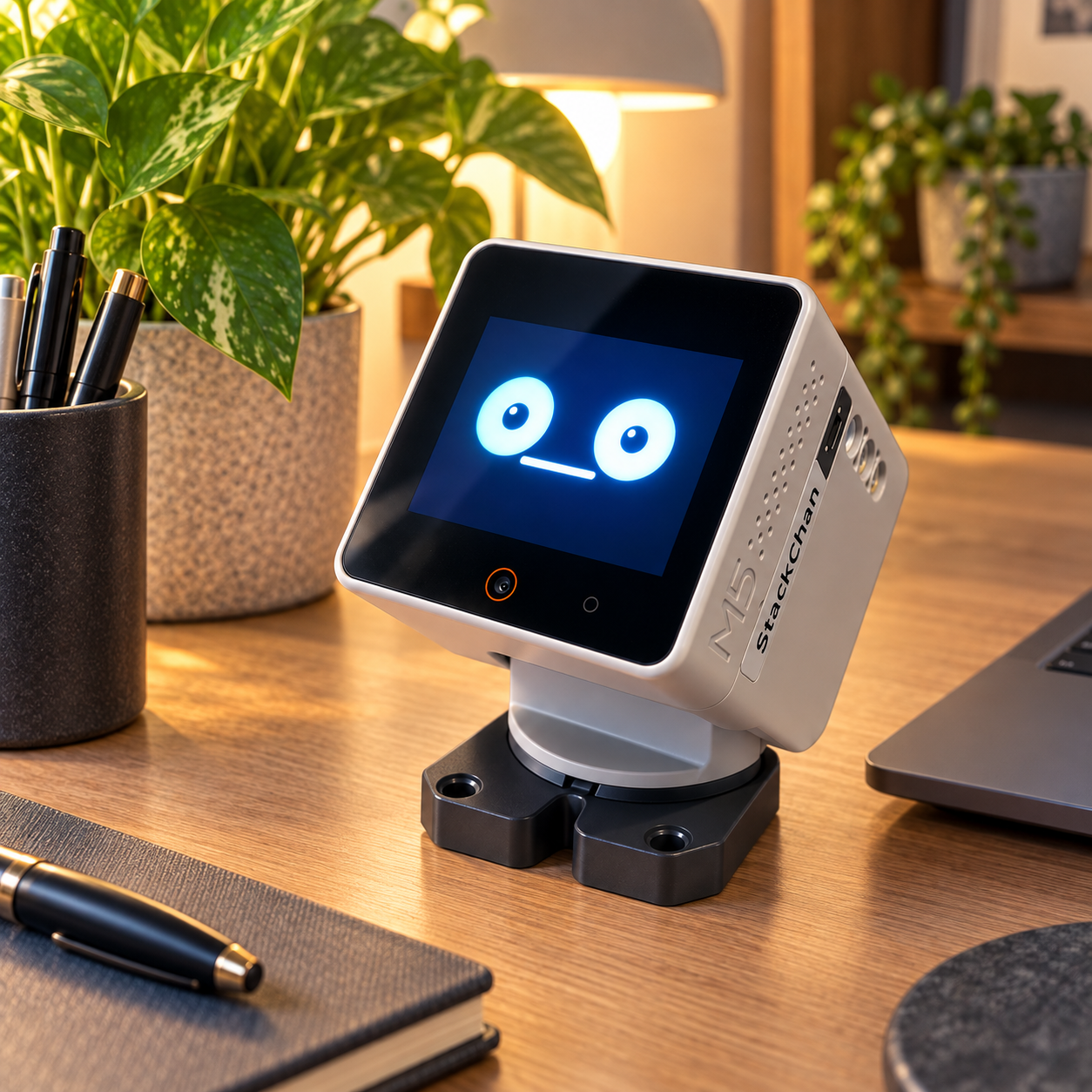
Mini Beacon, an M5Stack StackChan robot, sitting on a wooden desk.
MEET MINI BEACON A curious beginning, captured at the desk.

A companion with character

A cheeky little presence.

I began customising Mini Beacon, my M5Stack StackChan robot, through coding and AI-assisted development. She became a cheeky companion with a distinctive personality, expressive reactions and memorable conversations.

Working with her showed me how much personality and humour could influence the way humans interact with AI. That discovery became an important part of the path that eventually led me to start building Little Brain.

Two projects, two approaches

Two Different Ways to Build with AI

Both journeys take creativity and technical work. The difference is what we start with, and what we’re trying to change.

AN EXISTING ROBOT PLATFORM

Mini Beacon: Building with Existing AI

Mini Beacon is an M5Stack StackChan robot that Kai customised through coding. The robot platform was already there; Kai adapted software and used AI technology in the project to shape her cheeky personality, conversational behaviour and interactions.

Changing personality instructions or the code in an application can change how an existing AI system behaves. But that does not necessarily retrain its underlying language model.

We’re describing Kai’s customisation, not making claims about the specific model or internal architecture behind Mini Beacon’s interactions.

A SEPARATE LANGUAGE-MODEL EXPERIMENT

Little Brain: Building a Language Model from Scratch

Little Brain is a separate experimental language model. Kai is writing the training code and training small neural models using local examples. He is not a pretrained assistant with a new personality added.

During training, the model adjusts numerical settings called model weights. This helps it learn statistical patterns in the examples and predict which words may come next.

Little Brain is much less capable than a mature AI assistant, which is expected at this early stage. He produces patterns in words; we don’t claim he understands them as a person would.

In a nutshell: Mini Beacon is an existing robot Kai customised. Little Brain is a new small model Kai is training. Both take skill and imagination; they’re different kinds of development.

THE EXPERIMENT EXPLAINED

A few AI words, in everyday language.

Open a question to see what the term means. These notes are written for the website, not generated by Little Brain.

What is a pretrained model?

A model that has already learned patterns from examples before someone starts using it. You can build an app around it or guide how it replies, but that is different from training a new model yourself.

What are personality instructions?

Written guidance that asks an AI system to respond in a certain style or follow certain rules. They may influence replies without changing the model’s learned weights.

What does coding an application mean?

Writing the software that connects things such as screens, buttons, a robot and AI tools to make a usable project. An application can use an AI model without retraining that model.

What does training a model mean?

Showing a model examples and adjusting its numerical settings so its predictions better match those examples. Little Brain’s training examples are language, and the experiment looks at patterns in words.

What are model weights?

The learned numbers inside a model. Training adjusts these numbers, which changes the model’s predictions. They are not a list of instructions or proof that the model understands meaning.

What does “building from scratch” mean here?

For Little Brain, it means writing the training code and training small models without starting from a pretrained language model. It doesn’t mean inventing every AI method anew; it means Little Brain’s learned model comes from Kai’s own experiments.

What I learned

A physical project can change the questions you ask.

01

Personality matters.

A little character can change how an interaction feels. Mini Beacon made that clear to me.

02

Humour brings people in.

Playfulness can make a conversation feel more human and memorable.

03

One idea can lead to another.

What I learned with Mini Beacon helped lead me toward a much bigger question: what happens when I build and train an original model myself?

Two projects, two approaches

Connected by a journey. Different by design.

MY FIRST PHYSICAL AI ROBOT

Mini Beacon

An M5Stack StackChan robot I customised using existing technology, after gaining experience creating an AI-powered character.

THE ONGOING EXPERIMENT

Little Brain

A separate project: building and training an original AI model, and exploring whether it can develop its own distinctive sense of humour.

The real funny moments

The comedy shelf is waiting.

Mini Beacon has been part of some memorable conversations. No specific moment or quote has been added here yet; this space is for real examples Kai can verify and approve. The punchlines can wait until we have the receipts.